Cam Followers for the Food and Beverage Industry

It takes a lot of work for the food and beverage industry to keep supermarket shelves full of snack foods, drinks, meat, and poultry. To make these and other items, producers use equipment that can handle and process large product volumes. These machines operate at a fast pace and can keep up with inventory to supply customer demand. In factories, you will see a continuous flow of product movement. Machines must transport goods accurately and precisely from one location to another.
The same is true in the bottling industry. Machines perform can-necking processes, capping, rotary filling, and case packing. These machines have complex and various component structures working in unison to function as a system.
Cam Followers Keep Components Moving
Cam followers are some of these critical components. They transfer linear motion when transporting products. At the same time, cam followers support the load conditions in the application.
Cam followers are a type of bearing that supports radial load. They have thick outer ring cross-sections. In simplest terms, think of them as wheels on a train operating on a railroad track. Likewise, they operate on a track following a path as it supports the load in the application.
Cam followers have two styles:
-
Yoke type This style has a roller assembly installed with a customer supplied rod or pin slightly press-fitted inside the bore, held in place by a clevis-type housing.
-
Stud type The end of the stud type is threaded to a blind hole or a thru-hole secured with a hex nut.
Challenges for Cam Followers in Food and Beverage Production
Food and beverage production exposes cam followers to splashes from liquid product or washdown procedures. This liquid can be high in acidity or PH balance. In addition, food and beverage products may come in to contact with grease used to lubricate the cam followers. Cam followers use H1 food grade grease complying with EPA standards.
To eliminate rust or corrosion from occurring, material components should have corrosion resistance.
On the production line, cam followers operate on a continuous cycle. Operators rely on cam followers to last their expected life without disruptions, especially at peak production. Unexpected repair affects bottom line, resulting in costly downtime.
McGill® Cam Followers: The Innovation
McGill® Cam Followers were first introduced in 1935. McGill® Cam Follower’s Corrosion Resistant Engineered Solution (CRES) line is a problem solver for the food and beverage production industry. CRES has a track record of successful performance and a wide range of product offerings.
CRES components are available in stainless steel and lubricated with H1-compliant food-grade grease. CRES seals are constructed with a Lubri-Disc plus which combines with a thrust washer. It also has a rubber lip contact seal that is conformed on both ends, which contours the shape of the flanges. A wiping action along the flange surfaces prevents moisture from entering the bearing.
The RPB tapered roller bearing product uses a single lip style design and the USRB spherical roller product uses a double lip style design. McGill® CRES CAMROL® cam followers also incorporate advanced sealing with the LUBRI-DISC®+ system, enhancing contamination resistance and lubrication retention in dynamic applications.
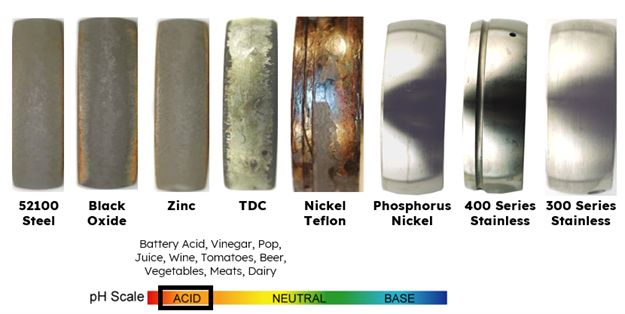
The corrosion resistance characteristics of coatings and stainless-steel solutions versus other options is likewise demonstrated below. Here we see side by side test results in which parts were exposed to acidic solutions (e.g. food/beverage processing), as well as base solutions (e.g. cleaning solutions).
Wet Box Acid Spray Test: Outer rings sprayed with Citric Acid (pH 2) for 8 hours
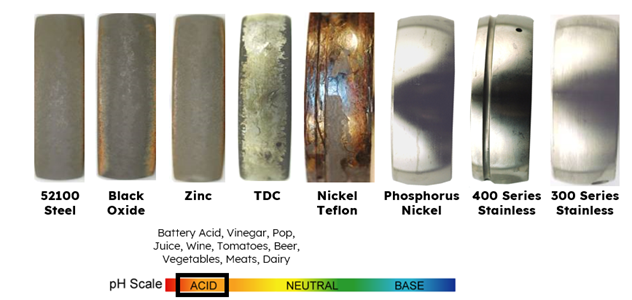
Wet Box Bleach Spray Test: Outer rings sprayed with 6% bleach solution (pH 12) for 8 hours