
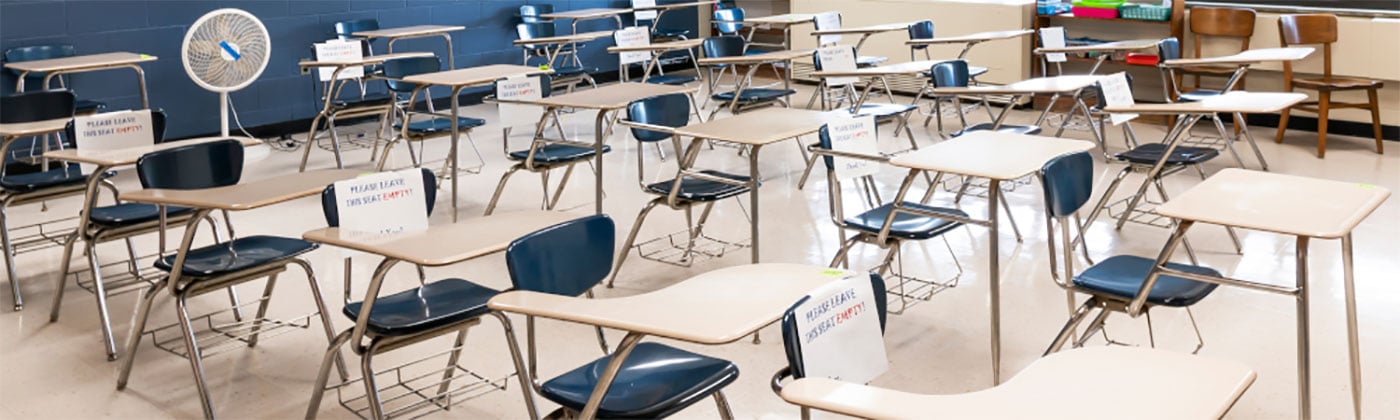
How to Improve Ventilation in Our Schools
In his executive order on reopening schools after COVID-19 shutdowns, President Biden has called on the departments of Education and Health and Human Services to provide guidance for a safe return to schools. Included in these measures are “cleaning, masking, proper ventilation, and testing.”
The need for proper ventilation is urgent and widespread. A government study released last June found that 41% of school districts need to update or replace HVAC systems in at least half their schools. This equates to around 36,000 schools nationwide.
Air Quality Awareness
COVID 19 has increased awareness of air quality and schools will be required to take steps to improve existing HVAC systems. According to the American Society of Heating, Refrigerating and Air-Conditioning Engineers (ASHRAE), improving air quality in buildings is one of the most effective ways to prevent illness caused by viruses and bacteria.
In order to improve ventilation in public buildings, ASHRAE, the Centers for Disease Control and Prevention (CDC) and the Environmental Protection Agency (EPA) all recommend:
- Running ventilation equipment at least 2 hours before occupants arrive, or 24/7
- Running nights and weekends, at least on low setting
- Switching air handling units with recirculation to 100% outside air when weather conditions permit
- Running ventilation in restrooms 24/7
MERV Rating Upgrades
The minimum efficiency reporting value (MERV) rating measures how effectively an air filter stops dust and contaminants from passing through the filter and into the air. MERV rating upgrades will help to mitigate the risks for COVID-19 exposure inside buildings. MERV 13 is being recommended as it provides a 67% improvement over MERV-4. The upgrade to MERV 13 significantly reduces the risk of occupant infection from viruses and bacteria. However, with this change to MERV 13, all mechanical power transmission components must be in peak operating condition to ensure proper air flow is achieved.
It is important to remember that increasing MERV levels will also increase resistance on the belt drive. This can cause:
- Belt drive tension
- Sheave wear
- Poor alignment
- Belt drive decay (which means you are losing airflow)
Belt Drive Improvements
Belt drives are an important piece of the HVAC system and not only have a role to play as far as efficiency, but also the safety and reliability of the HVAC systems to improve occupancy comfort and mitigate risks against airborne viruses.
Upgrading V-belts can be a cost-effective way for schools to improve ventilation without replacing entire HVAC systems.
The TorqTitan™ Notched V-Belt is the industry’s first zero-maintenance V-belt. Designed to be the most efficient notch design you can get out of a belt, the TorqTitan™ Notched V-Belt transmits 30% more HP than previous belts. There is no need to re-tighten the Titan, eliminating maintenance and increasing efficiencies. It will run in the same sheaves that are currently used and is a simple upgrade/replacement part.
Retrofit an Existing System
School districts should consider a retrofit of their existing HVAC belt drives as a way to improve their ventilation. In addition to improved air quality for students and faculty, additional benefits to upgrading to a TorqTitan™ Notched V-Belt include:
- Increase V-belt drive efficiency from 95% to 98%
- Cost savings due to energy reduction
- Cost savings due to maintenance reduction
- Cost savings due to Component reduction
- Weight savings