
How the Right Coupling Can Boost Gas Compressor Efficiency
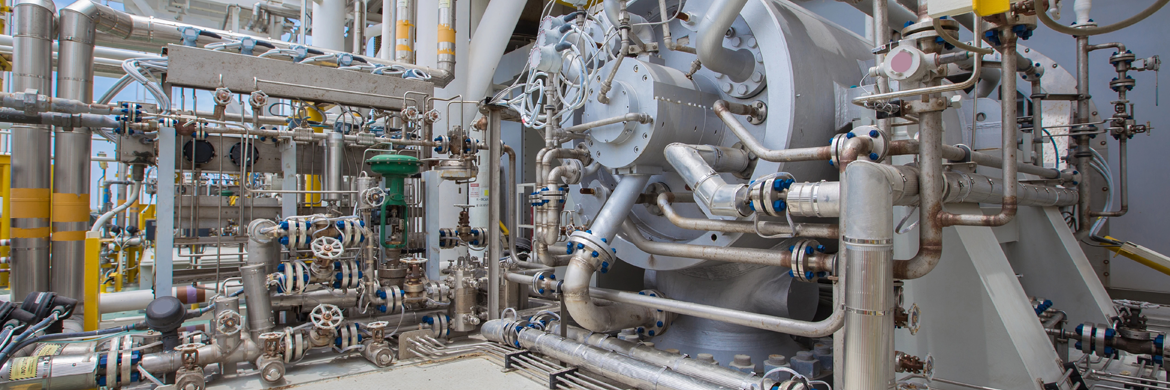
In the Oil and Gas industry, natural gas compressors are used in every stage of the process from exploration and transportation to storage, processing and distribution. There are two main types of gas compressor designs: reciprocating and non-reciprocating (screw, centrifugal).
Reciprocating compression typically happens in three stages. A piston uses pressure to compress the gas. This begins with the gas being drawn into the compression cylinder, where the pistons reduce the gas volume through compression. The gas is cooled and then compressed again two more times before getting to its final pressure.
Non-reciprocating compression is less complex than reciprocating compression but does not achieve as high of pressures. In screw compression, gas passes through rotary screws and is progressively compressed as it is moved through the space between the screws, generating heat and increasing gas pressure. This method is typically used for smaller applications that require less gas at lower pressures. In centrifugal compression, gas enters the compressor, and an impeller spins it rapidly. This spinning increases the gas speed and energy level before moving through the diffuser to slow it down and convert the kinetic energy into higher pressure.
Regardless of the method, compressors require precise, well-designed components to prevent gas leaks and to dissipate heat during compression.
Naturally, the push for increased reliability, greater environmental sustainability, and cost-savings are driving this expansive market. Stakeholders in the industry are focusing on energy-efficient solutions as compressors consume a substantial amount of energy, with only a small amount being effectively utilized. Much of the energy a compressor application generates is dissipated as heat. Additionally, maintenance costs, especially for engine-powered compressors, are a significant challenge as parts, filters, and lubricants can be expensive to replace.
These factors have led to the increased adoption of electric motors for compressors, as they are not only more energy efficient, but are also less expensive to maintain and are speed adjustable. However, this electrification requires reliable access to electricity, which is more difficult in remote areas, where local power generation is then required.
Which Coupling is the Best Fit for Your Gas Compressor?
Selecting the right coupling for a gas compressor application is key to the success and longevity of the system. Typically, the types of couplings used in gas compression are disc couplings and torsionally soft, elastomeric couplings. To select the best coupling for your application, you must consider the type of driver (internal combustion engine or electric motor), power, operating speed, and any torsional requirements.
Disc Couplings
- Preferred for fixed and high-speed, high-precision applications
- Ideal when alignment can be well-controlled
- Suitable for environments with wide temperature variations
- Preferred in applications where space is limited
Torsionally Soft Couplings
- Best for applications requiring high vibration damping and shock absorption
- Suitable for high-torque, variable speed and load, and pulsating load applications
- Ideal for installations with potential misalignment
- Preferred when torsional resonance tuning is necessary, such as with an AC motor and variable frequency drive or when noise and vibration reduction is critical.
The broad Regal Rexnord coupling portfolio and engineering expertise ensures success in finding the best coupling for your gas compressor application. The breadth of designs accommodates everything from smoother electric-driven gas compression applications to higher vibration engine-driven applications. The right selection and calculation of the coupling, the use of high-quality materials, and the correct design and dimensioning leads to the highest durability and increased reliability, reducing costs and improving efficiency.
For applications where disc couplings are the right solution, Rexnord™ Thomas™ XTSR, Thomas AMR, Thomas CMR, Thomas Series 54 and 54RDG couplings provide highly reliable and economical solutions for the gas compression industry.
CENTA™ highly flexible, torsionally soft couplings are ideally suited for gas compression applications subject to high vibratory loads or torsional vibration issues. CENTAX-B, CENTAX-G, and CENTAFLEX-A couplings are highly customizable solutions that meet the torsional requirements of demanding applications.
For applications allowing for a different type of coupling, Rexnord Omega™, Viva™, and TB Wood's™ Sure-Flex Plus™ elastomeric couplings and Falk™ Steelflex™ grid couplings are highly reliable solutions that can offer more economical solutions for simpler applications.
With years of industry leadership and a wide portfolio of trusted brands, Regal Rexnord engineering should be your trusted solutions provider for all your gas compression flexible coupling needs. Regal Rexnord engineers also bring years of experience in torsional vibration analysis (TVA) for torsionally soft couplings. Torsional vibration refers to the ‘twisting’ movement of the rotating shafts that connect the various pieces of equipment in a drivetrain. Utilizing TVA can prevent downtime and protect your equipment from operating at potentially dangerous resonance frequencies. The coupling and shaft designs in the Regal Rexnord portfolio are subject to extensive torsional vibration analysis, multi-mass, and finite element analyses.
From our dedicated team of torsional vibration experts to our advanced design and testing facilities, we understand the needs of the market and can assure a coupling solution guaranteeing the most efficient operation for all your compression operations – anywhere in the world.