
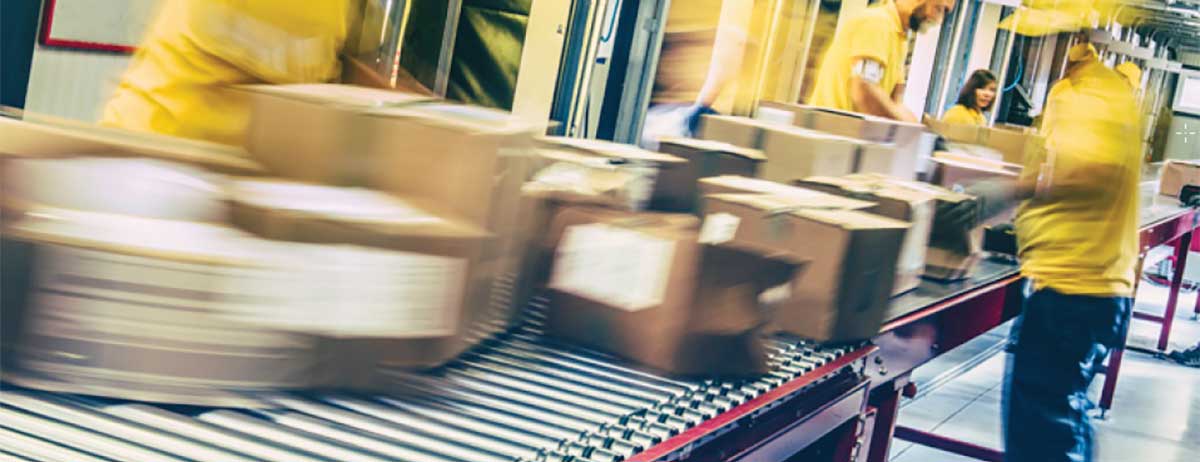
Revolutionizing Automated Conveying
The Regal Rexnord® ModSort® Module Solves Challenging Sortation Issues
Related Resources
Unit Material Handling Industry Trends
Changing trends in the unit material handling industry have brought new operational challenges for distribution centers (DCs). New consumer buying habits have in part fueled the rise of e-commerce and hastened the decline of brick-and-mortar stores. And e-commerce transactions are only expected to continue to grow. The Power Transmission Distributor Association (PTDA) forecasts an 8.6% growth in unit material handling in 2021, i.e., distribution centers will need to work faster and more efficiently in order to keep up.
The exponential growth of e-commerce means distribution centers are now tasked with sorting a wider variety of package types, from boxes to polybags to jiffies to flats. But at the same time, new technologies — such as artificial intelligence (AI) and wireless sensors — can reduce the operational reliance on manual processes and increase predictive maintenance capabilities. Sortation systems that can flex capacity allow DCs to easily adapt to regional demand changes and prepare for a burst of activity around holidays. Additionally, COVID-19 has highlighted the need to implement non-manual sortation practices and social distancing as much as possible.
In addition to all of these changes, DCs continue to face productivity improvement and cost control challenges. As they sort a greater variety of package types, they will need to obtain a lower cost per sort and reduce the number of missorted items. Throughput is expected to increase to keep up with demand. Employees and equipment are expected to do more each shift. And at the same time, safety standards pertaining to noise and ergonomics must be met.
Distribution centers need new solutions to adapt to changing trends and increase efficiency and productivity. One solution includes leveraging automated sortation systems to reduce manual labor and free resources for higher-value activities.
Sortation System Options
DCs and conveyor integrators have several sortation systems available to them, based on product type, product weight, fragility and packaging types. High-speed options include shoe sorters, which handle fragile products of various sizes well; and tilt-tray sorters, which have a high throughput rate. These systems, however, can take up significant square footage; thus, additional shoe or tilt-tray sortation zones cannot be added or subtracted to scale for demand.
Pusher systems use pneumatics to move the arms to divert packages, but this system is not ideal for fragile products. Cross-belt sortation systems, which are useful when items are difficult to sort, cannot be modified.
Another option includes pop-up sorters that use belts to lift or divert product down a line. These can be modular, i.e., sections can be added or removed as needed. These modular systems give distribution centers the ability and flexibility to scale based on demand.
Regal’s ModSort Modular Right-Angle Transfer Station
In 2017, Regal introduced the ModSort Modular Roller Top Right-Angle Transfer and Diverting Station as its solution to industry challenges. The product was designed to solve the range of increasingly challenging transfer and diverting problems complicating operations in distribution centers, particularly retail e-commerce distribution. Learn more about ModSort Systems.
How the ModSort Station Works
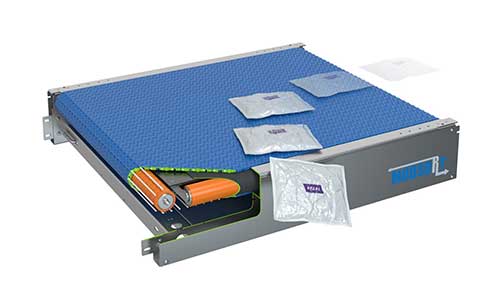
Unlike other systems that use force to divert objects, the modular roller top belt station uses motion control. The use of rotating spheres gives it a high degree of motion control and the ability to convey packages in any direction. The roller top belt embeds a uniform array of independent 1-inch, on-center spheres on a continuous, low-profile, gap-free interlocking plastic belt. Traditional horizontal conveyor rollers are unidirectional, whereas spinning spheres make use of all 360 degrees of potential motion. The belt and spheres are powered by one or more activated running belts underneath the station. By using different configurations of motorized roller belts and controlling the relative speeds of each belt, the station can be configured for specific transfer and diverting operations.
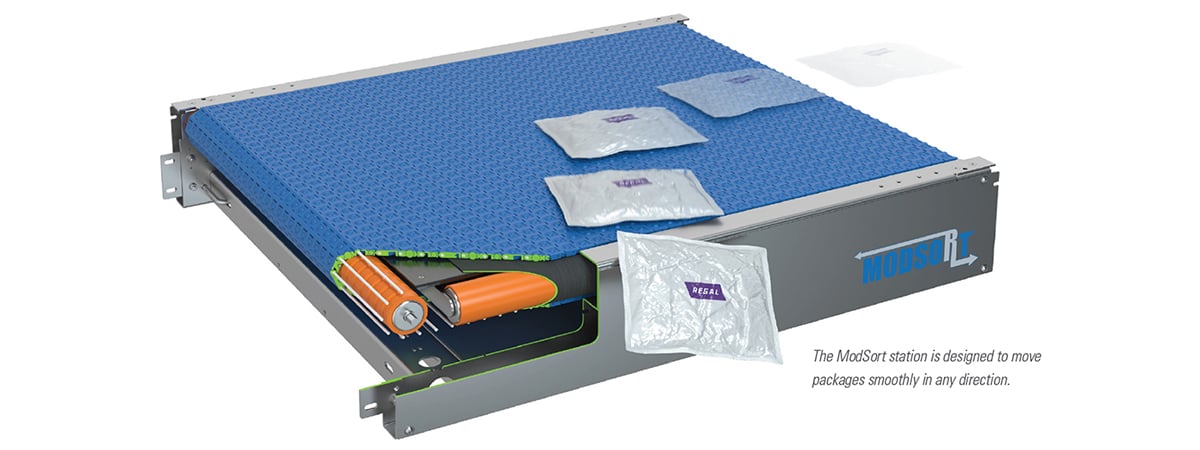
The roller top belt can also accelerate or decelerate objects, move any object to an angle vector at a given speed, or simply stop and rotate a product into a specific orientation. No other handling equipment is needed. The roller top belt uses few moving parts and has minimal power demands. Compared to lifters or pusher arms, the ModSort station provides a smooth, jolt-free, 90-degree motion. It gives distribution centers all these features along with the flexibility and simplicity of a modular and easily configured and maintained system.
Scalability and Flexibility
The modular design of the ModSort station solves two of the biggest problems with conventional conveying divert stations: scalability and flexibility. Fixed conveyors are designed to accommodate a specific demand throughput and fit a certain building configuration. Patented ModSort technology allows sortation zones to be easily expanded for increased demand by adding modules over time. It can be integrated into existing traditional or motorized rolling conveyors. ModSort stations are also portable. They can be redeployed at another location or rolled off to the side for use at a later date, or when demand changes.
Furthermore, the ModSort module can handle an increasingly diverse range of package sizes and shapes and is especially ideal for polybags and smaller packages. Using the matrix of freely rotating spheres embedded into a continuous flat belt, the roller top belt station diverts and transfers products of any kind by using precise, controlled and impact-free motion to move products along motorized conveyor lines.
Productivity Improvements
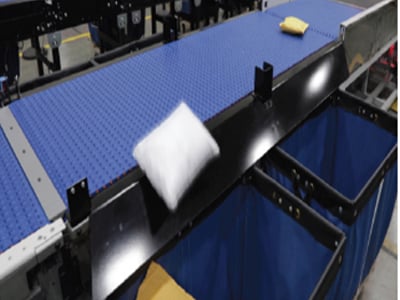
As a last-mile sorter, the ModSort module eliminates the need for manual sortation. Moving small packages or polybags required putting them into tubs for handling, then hand-sorting the materials at the end of a line: a time-consuming, labor-intensive extra step. Workers who no longer need to manually sort packages can now be redeployed for higher-value tasks.
Another issue DCs face when handling small or soft packaging is the gaps between rollers on standard conveyor stations, as products literally fall through the cracks. It requires time and labor to retrieve items, which reduces throughput and exposes workers to potential safety hazards. The ModSort module embeds the rotating spheres in a continuous, interlinked belt surface, which is flat and free of gaps.
To meet rapid demand changes, the simple and modular design of the ModSort module means it can be integrated and reintegrated into a line and given new tasks that it can often accomplish within a few hours. The line can be up and running faster and keep throughput rates at the optimal levels based on the needs of the distribution center.
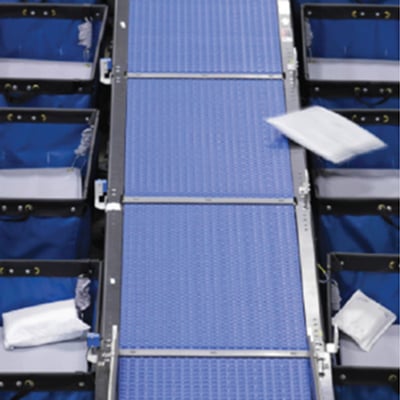 ModSort Module is ideal for small packages and polybags
 Ergonomics and Safety
The ModSort station is driven by a variable-speed, run-on-demand, 24-volt DC motor, which is not only energy-efficient, but also allows for flexibility and simplicity in wiring and control. It provides a safe and quiet operation (<70 dBA), as well as minimal, easy maintenance. Its design allows the belts to be swapped out for repairs or replaced quickly. Additionally, the roller-free belt design improves worker safety. With no gaps or pinch points anywhere, workers face a much lower risk of injury.
Without the need for manual sorting, workers no longer need to stand side-by-side or in close proximity on a line. Distribution centers that need to keep operating at maximum efficiency while maintaining social distancing will benefit from the use of a ModSort system.
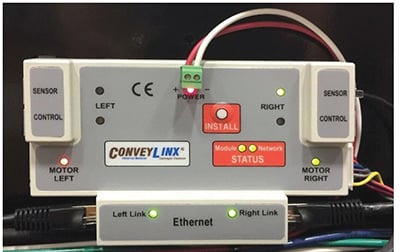 ModSort Control Panel
Durability and Maintenance
The ModSort module belts are made from blue acetal, and the imbedded spheres are made from a tough and wear-resistant polyamide. The result is high belt strength combined with low friction and at a much lower weight than metal components. Due to their unique design, the spheres can double in speed while the belt does not accelerate, which reduces wear and tear on the belt, extending its life. Furthermore, the low weight and reduced friction contribute to a significantly lower power demand. Modular roller top belt systems can achieve energy savings of 50 to 60% compared to other conveyor transfer systems — in addition to the savings realized by eliminating the labor-intensive step of re-processing small or plastic packages conveyed in tubs.
Users of the ModSort station can also realize inventory and maintenance savings. It costs less to maintain a spare parts inventory of modular plastic belts than an inventory of pneumatic lift and compressor systems. ModSort components can also be replaced in a matter of minutes, eliminating the hours of downtime for repairs with other systems.
ROI, COST SAVINGS AND CUSTOMER RESULTS
The Regal ModSort team has developed a cost savings calculator to help integrators and potential customers see the operational value of the ModSort system. With the calculator, the team can compare the costs of installing the ModSort module to current systems, as well as demonstrate the long-term benefits and return on investment (ROI) of the system. The team factors throughput, conveyor size, product weight, energy consumption and safety concerns into their calculations.
Customers who have integrated the Modsort module into their lines have seen the benefits. One ModSort module customer had an employee standing next to a conveyor line to feed packages across a table with rolling elements into an X-ray machine. A few days after the company installed a ModSort module in this area of the line, the employee was redeployed to higher-value tasks, and the chance of injury associated with repetitive motion was reduced.
The head of safety and quality control for another customer wanted to eliminate pusher bar sorters to reduce employee injuries. The ModSort module was able to replace the pusher bars to their satisfaction, and now the customer is considering the ModSort system as a replacement for all pusher bars in other facilities.
Talk To Our Sales Team
We're here to help. Our team of experts is ready to help energy-efficiently power your business.
Brands


