
What is a Coupling? Types of Shaft Couplings, Features, and Applications

What is a Coupling?
What is a coupling? A coupling serves as a mechanical interface between two shafts, primarily tasked with transmitting power from the driving shaft to the driven shaft. Additionally, couplings are designed to accommodate minor misalignments between the shafts.The Role of a Coupling
- Connect two pieces of equipment
- Transmit torque from one rotating shaft to another
- Accommodate misalignment

Couplings transmit torque from one rotating shaft to another.
There are two main categories of couplings: material flexing and mechanical flexing. Material flexing coupling types obtain their flexibility from stretching or compressing a resilient material, such as rubber, or from the flexing of thin metallic discs or a grid. Material flexing couplings do not require lubrication.
Mechanical flexing couplings accept misalignment from the rocking, rolling, or sliding of metal surfaces. All metal mechanical flexing couplings require lubrication.
Types of Material Flexing Couplings
Material flexing coupling types operate in shear or compression and are able to accept angular, parallel, and axial misalignment.
Examples of material flexing couplings are jaw, sleeve, tire, disc, diaphragm, and torsionally soft.

Material flexing couplings accept angular, parallel, and axial misalignment.
1. Jaw Couplings
The jaw coupling is a material flexing coupling that transmits torque through compression of an elastomeric spider insert placed between two intermeshing jaws.
Features:
- Flex element is commonly made of NBR, polyurethane, Hytrel, or bronze
- Accommodates misalignment
- Transmits torque
- Used for torsional damping (vibration)
- Low torque, general purpose applications
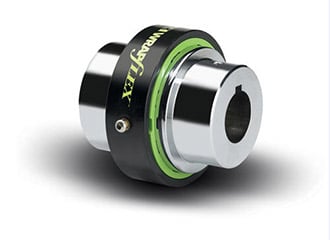 Falk™ Wrapflex™ Elastomeric Jaw Couplings
 2. Sleeve Couplings
The sleeve coupling transmits low to medium torque between connected equipment in shear through an elastomeric insert with male splines that mate with female hub splines. The insert material is typically EPDM, neoprene, or Hytrel and the insert can be a one or two-piece design.
Features:
- Accommodates moderate misalignment
- Torsional damping (vibration)
- End float with slight axial clearance
Applications:
- Low to medium torque, general purpose applications

TB Wood’s™ Sure-Flex Plus™ Sleeve Couplings
3. Tire Couplings
Tire couplings have a rubber or polyurethane element connected to two hubs. The rubber element transmits torque in shear.
Features:
- Reduces transmission of shock loads or vibration
- High misalignment capacity
- Easy assembly without moving hubs or connected equipment
- Moderate to high-speed operation
- Wide range of torque capacity
Applications:
- General purpose applications
- Pumps and compressors
- Blowers and industrial fans
- Runout tables
- Mixers
- Chippers and saws
 Rexnord™ Omega™ and Viva™ Tire Couplings
 4. Disc Couplings
The disc coupling works by transmitting torque through flexing disc elements. It operates through tension and compression of chorded segments on a common bolt circle bolted alternately between the drive and driven side. These couplings usually consist of two hubs, two-disc packs, and a center member. A single disc pack can accommodate angular and axial misalignment, while two-disc packs are required to accommodate parallel misalignment.
Features:
- Accommodates angular, parallel, and axial misalignment
- True limited end float design
- Zero backlash design
- High speed rating and balance
Applications:
- General purpose and industrial applications
- Ideal for power generation applications including gas and steam turbines
 Rexnord Thomas ™ XTSR52 Disc Couplings
 5. Diaphragm Couplings
Diaphragm couplings utilize a single or series of plates or diaphragms for the flexible members. They transmit torque from the outside diameter of a flexible plate to the inside diameter, across the spool or spacer piece, and then from inside to outside diameter. The deflection of the outer diameter relative to the inner diameter is what occurs when the diaphragm is subject to misalignment. For example, axial displacement attempts to stretch the diaphragm, which results in a combination of elongations and bending of the diaphragm profile.Features:
- Accommodates angular, parallel, and high axial misalignment
Applications:
- High-performance applications in power generation
- Used in high torque, high-speed applications
 Ameridrives™ Ameriflex™ Diaphragm Couplings
 6. Torsionally Soft Couplings
Torsionally soft couplings incorporate an elastomeric component to minimize harmful torque spikes. These couplings enhance shock absorption and vibration damping, resulting in quieter operation and a more comfortable experience for the user. By shifting torsional resonances to below the operating speed range, they safeguard both the driver and the driven equipment from torsion-induced failures.Features:
- Elastomeric element provides vibration damping
- Self-ventilating design
- Rubber element varies in shore hardness enabling torsional flexibility
- Hubs can be customized to fit any kind of mounting and application
Applications:
- Applications requiring high vibration damping and shock absorption
- Pumps, compressors, diesel engines, marine propulsion, and large industrial machinery

CENTAMAX™ Torsionally Soft Couplings
Types of Mechanical Flexing Couplings
Mechanical flexing couplings accept misalignment from the rocking, rolling, or sliding of metal surfaces. All metal mechanical flexing couplings require lubrication.
Examples of mechanical flexing couplings are gear, grid, fluid, barrel, and roller chain couplings.
1. Gear Couplings
Gear couplings transmit the highest torque of any flexible coupling, even in the smallest diameter configurations. Each gear coupling consists of two hubs with crowned external gear teeth. The hubs mesh with two internally splined flanged sleeves that are bolted together. Gear couplings accommodate angular and axial misalignment by the rocking and sliding of the crowned gear teeth against the mating sleeve teeth. Parallel misalignment is accommodated by having two adjacent hub/sleeve flex points. Gear couplings require periodic lubrication depending on the application. They are sensitive to lubrication failures but if properly installed and maintained, these couplings have a service life of 3 to 5 years and in some cases, they can last for decades.Features:
- Crowned external gear teeth
- Accommodates angular, parallel, and axial misalignment
Applications:
- Ideal for general industrial applications with high torque and misalignment

Falk Lifelign™ Gear Couplings
2. Grid Couplings
Grid couplings consist of two radially slotted hubs that mesh with a serpentine strip of spring steel. The grid component provides the torsional damping and flexibility of elastomer but with the strength of steel. Grid couplings transmit torque and accommodate angular, parallel, and axial misalignment from one hub to the other through the rocking and sliding of a tapered grid in the mating hub slots. The grid cross section is generally tapered for better hub contact and easier assembly. Due to the movement between contacting hub and grid metal parts, lubrication is required.Features:
- Grid component provides torsional damping and flexibility with steel strength
- Accommodates angular, parallel, and axial misalignment
- Tapered grid section for easy assembly
Applications:
- Suited for cement and aggregate, paper and forestry, metal forming, and general industrial applications
 Falk Steelflex™ Grid Couplings
 3. Fluid Couplings
Fluid couplings, often referred to as hydraulic couplings, are designed to offer a gentle start and controlled acceleration to the driven machinery, which helps minimize shock and wear. Moreover, fluid couplings act as torque limiters, safeguarding the driveline from sudden overloads by permitting the driving component to spin freely if the load exceeds a safe threshold.Features:
- Soft, cushioned starts
- Increased starting torque
- Overload protection
- Load balancing for multiple drives
- Load damping maximizes equipment life
- Reduced starting current draw
- Speed variation for multi speed applications
Applications:
- Applications requiring smooth and efficient torque transmission
- Heavy machinery applications such as such as mills, crushers, conveyors, and pumps
 Falk True Torque™ Fluid Couplings
 4. Barrel Couplings
Barrel Couplings absorb high misalignment and have less bending stress wear, allowing for longer coupling life. Barrel couplings are designed with a sleeve provided with semicircular toothing surrounding its internal diameter and a hub that has a similar toothing over its external diameter. Specially hardened barrels are inserted into the hub and sleeve pockets.Features:
- High torque capacity
- Increased axial misalignment tolerance
Applications:
- Crane and hoisting applications
- Steel mills
- Winches and conveying
- Stackers and conveyors
 Jaure™ Barflex™ TCBR Barrel Couplings
 5. Roller Chain Couplings
Roller Chain type couplings consist of two radially sprocketed hubs that engage a strand of double pitch roller chain. The meshing of the sprocket teeth and chain transmits torque, and the associated clearances accommodate angular, parallel, and axial misalignment. Chain couplings require periodic lubrication depending on the application. The lubrication is typically brushed onto the chain, and a cover is used to help keep the lubrication on the coupling.Features:
- Accommodates angular, parallel, and axial misalignment
- Radially sprocketed hubs engage double pitch roller chain
Applications:
- Low to moderate torque and speed applications
 Morse™ Roller Chain Couplings
 Key Features of Regal Rexnord Couplings
- Made with high-performance materials
- Expertly engineered
- Misalignment accommodation
- Absorb shocks and vibration
- Broad portfolio of couplings from trusted brands
Why Choose Regal Rexnord Couplings?
At Regal Rexnord, we provide a wide variety of couplings from trusted brands. Our experienced engineers can custom-design coupling solutions tailored to your specific application, ensuring reliable performance even in the most challenging scenarios.
Learn More
To learn more about all of the different types of couplings, visit Regal Rexnord's industry-leading coupling products.
Talk To Our Sales Team
We're here to help. Our team of experts is ready to help energy-efficiently power your business.

Bob Lennon – Coupling Industry Expert
Bob Lennon has over 40 years of experience, specializing in the torsional couplings market. As an industry manager, he wears many hats, from global business development to serving as a subject matter expert for the power generation and marine propulsion industries.