
What is Catenary Sag?

According to the Merriam-Webster Dictionary, Catenary is, "the curve assumed by a cord or uniform density and cross section that is perfectly flexible but not capable of being stretched and that hangs freely from two fixed points". When discussing conveying chain, catenary sag refers to the hanging shape the sagging chain takes after leaving the drive sprockets. Proactively checking the catenary sag of your chain can increase drive efficiency, identify chain elongation and help predict chain removal or replacement. We recommend that all conveying chains are run with a certain amount of catenary sag, so checking it early and often is critical to maintaining the long term health of the conveying line.
To measure catenary sag, the chain needs to be under tension, in operation and observed from a safe distance to avoid injury. Follow these steps to attain your line's catenary sag:
1. Mark your starting points
The sag is measured from an imaginary line running from the bottom of the drive sprockets, to the beginning of the chain return.
2. Measure length and height
The recommended open horizontal span is generally 18 to 24 inches. The recommended vertical sag is 3 to 5 inches when running under load. This results in proper engagement between the drive sprockets and the chain. It is important to add measuring catenary sag to your regular maintenance as chain links will wear and stretch over time. Consistent measuring can help ensure the health of your conveying line and increase it's service life.
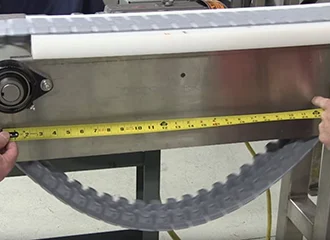
3. Adjust based on measurement
If the catenary sag is too great or too little, you must add or remove chain links until your achieve the desired length.
What Causes Catenary Sag?
The chain will elongate over time due to hinge wear caused when the chain links flex when they engage and disengage the head and tail sprockets. I recommend checking chain sag at least once per month. Remove chain lengths as required to maintain proper chain sag. If the sag is too long, shut off your conveyor, and follow Lockout-Tagout (LOTO) procedures. Remove the pin from one chain link near the drive sprocket so the chain can be supported. Pull the overlapping ends of the chain hand-tight to determine how many lengths can be removed. Remove the excess links and reconnect the chain. Restart the conveyor and measure the catenary sag again to ensure it falls within the recommended measurements.
Visit the Regal Rexnord Conveyor Technologies page for more information on products such as installation manuals, videos and product specifications.
Talk to Our Sales Team
We're here to help. Our team of experts is ready to help energy-efficiently power your business.
Michael Mersberger
Michael is a FlatTop Application Engineering Manager for Rexnord. He has more than 20 years of experience as an engineering manager and is a subject matter expert in the conveying industry, with specific expertise in sustainability for beverage processing applications.