
9 Things to Know about Genteq™ UVantage™
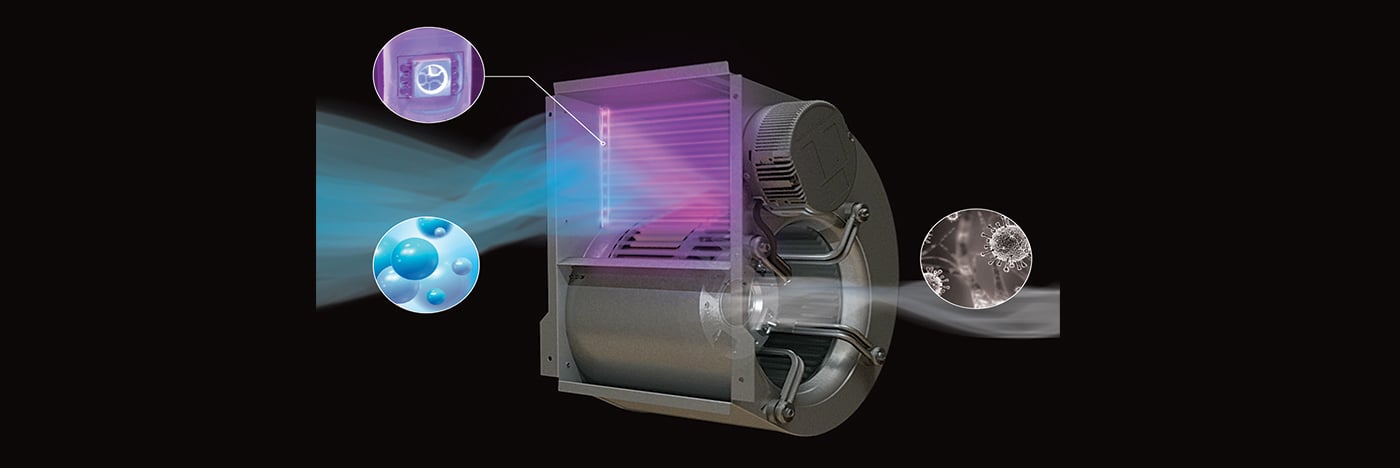
UVantage™ is an Indoor Air Quality (IAQ) system that that generates UVC radiation to sterilize pathogens in an airstream within an HVAC blower. UVC systems need to be tuned to provide enough intensity to properly sterilize pathogens, as different viruses require different dosing intensities. UVantage is designed for high energy doses and appropriate for viruses such as SARS-CoV2, the virus that causes COVID-19 and a host of other viruses.
UVantage is a sterilization solution that works well with existing HVAC system design. We recommend designers and operators of HVAC system follow industry-recommended practices of regular filter maintenance and use of fresh air to help diffuse pathogens in indoor air.
Here are nine things to know about Genteq UVantage:
1. UVantage is Safe
UVantage uses UVC LED lights, which unlike UVA or UVB do not emit skin cancer-causing radiation. Extended exposure to UVC can cause erythema (reddening of the skin) and conjunctivitis. The risk of extended exposure is mitigated by containing UV-C within the UVantage blower and only operating when the blower is operating. Technicians and homeowners should never have a light-leak situation in normal operation. In addition, UVantage follows the guidelines from the EPA and UL, with adequate labeling for safe operation.
The UV-C is contained within the blower and shielded by HVAC equipment and ductwork. UVantage generates zero ozone or other byproduct which could adversely impact air quality. In fact, UVantage disables a pathogen’s ability to reproduce, which is why we call it a sterilization technology. No additional side effects and/or byproducts are created. No change in air particle charge or smell results.
2. Intended Applications for UVantage
UVantage is intended for residential and light commercial applications, including schools.
3. UVantage Doesn’t Harm Components
Since UVantage is contained within the blower, the metal surfaces, exposed wiring and filtration material are the only contact surfaces. UVC is a non-penetrating wavelength of UV light and not shown to degrade polymers or metals.
4. When to Replace UVantage Module
UVC modules have a GREEN LED indicating the operation of UVC modules. Also, present UVC LEDs have a purple color when operating. UVC can be measured but requires specialized equipment. Due to the long-life nature of UVC LEDs, a rule of thumb is to replace UVC modules every 7 years, however no current method demonstrates a need to replace the modules.
Life depends on operating time and temperature of UVC LEDs. Regal Rexnord has a lifetime model which we use with HVAC equipment manufacturers to make sure the sterilization impact will last a minimum of 7 years in the intended application (home, school, hospital, etc.).
5. Effectiveness at Different Airflow Rates
The effectiveness of disinfecting a given space is independent of airflow level (CFM). Lower airflows provide a higher disinfecting percentage per cycle; however, it takes more cycles to disinfect the entire space. At lower airflow, the "dosage" (LED radiation intensity multiplied by the time spend in blower) is much higher than at higher airflows. Smaller air-conditioned spaces can benefit from smaller dosages which can be achieved by modulating LED Flux. Regal Rexnord works with OEMs to offer a customized solution based on application requirements.
6. Recommended Control and Wiring
UVantage LED UV-C module is powered from a universal input (120, 240, or 277VAC power source). This power source provides DC power to an LED module that needs to be energized only when the blower is operating. In most HVAC systems, the blower operates when either G, Y, or W signals are energized (24V applied).
7. UV LED Power and Wavelength
The UV LED lights consume less than 40W and emit a wavelength of 275nm +/- 5nm.
8. UVantage Certifications
A single UL standard does not apply to the use of UVC LEDs and sterilization. The product category is regulated by the United States Environmental Protection Agency (EPA), with whom Regal Rexnord is registered. We continue to work with UL and other safety-standard making bodies to ensure safe products reach customers.
9. UVC Technology vs. Ionizers
Ionization and UVC are entirely different and deliver improved air quality in different ways. Ionizers are claimed to generate positively and/or negatively ions which collect on pathogens and “weigh them down” causing them to drop out of the air so they are not inhaled. Some ionizer manufacturers claim that the ions bond with the actual pathogen’s protein structure and cause it to not replicate. This is an undocumented feature. UVC impacts a pathogen by altering the pathogen’s molecular structure rendering it sterile, unable to be replicated.