
Why Use A Drive with Your Motor?

Drives are a common component in the industrial motor market. But why would you need a drive for your electric motor? Drives (or controls) offer greater customization and control over a motor’s output. Let’s dive into what drives can do and the options you have when selecting a drive.
To start, there are two basic drive types, each related to the type of motor controlled – DC and AC.
All About DC Drives
What Is A DC Drive?
DC (direct current) drives control the speed of a DC motor. DC drives vary the armature voltage (and sometimes also the field voltage).
How DC Drives Work
DC drives are easy to apply and technologically straightforward. They work by rectifying Alternating Current (AC) voltage from the power line to DC voltage. The drive then feeds adjustable voltage to a DC motor. Drives on permanent magnet DC motors only control the armature voltage. The more voltage supplied, the faster the armature turns. With wound-field motors, the drive must supply voltage to both the armature and the field.
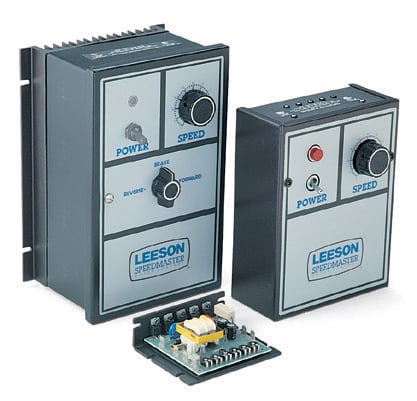
The Three Common Types of DC Drives
DC SCR Drives
Named for the silicon-controlled rectifiers (or thyristors) used to convert AC to controlled voltage DC. DC SCR drives are inexpensive and easy to use. These drives come in a variety of enclosures, and in unidirectional or reversing styles.Regenerative SCR Drives (or Four Quadrant Drives)
Regenerative SCR drives allow the DC motor to provide both motoring and braking torque. Power coming back from the motor during braking is regenerated back to the power line and not lost.
Pulse Width Modulated DC Drives (PWM or Transistorized DC Drives)
These provide smoother speed control with higher motor efficiency and less motor heating. Unlike SCR drives, PWM types have three elements. The first converts AC to DC. The second element filters and regulates the fixed DC voltage. The third element controls average voltage by creating a stream of variable width DC pulses. The PWM drive has improved performance compared to common SCR drives. This is due to the filtering section and higher level of control modulation.
All About AC Drives
What Is An AC Drive?
An AC drive controls the speed of an AC motor by varying the frequency and voltage supplied to the motor.
How AC Drives Work
AC drive operation begins in much the same fashion as a DC drive. Alternating line voltage is first rectified to produce DC. Because an AC motor is used, this DC voltage must be changed back (or inverted) to an adjustable-frequency alternating voltage. The drive’s inverter section accomplishes this. In years past, SCRs accomplished this. Modern AC drives use a series of transistors to invert DC to adjustable-frequency AC. This synthesized alternating current is then fed to the AC motor at the frequency and voltage required to produce the desired motor speed.
For example, a 60 Hz synthesized frequency (the standard line frequency in the United States) produces 100% of rated motor speed. A lower frequency produces a lower speed, and a higher frequency a higher speed. In this way, an AC drive can produce motor speeds from approximately, 15 to 200% of a motor’s normally rated RPM. The drive does this by delivering frequencies of 9 Hz to 120 Hz, respectively.
Today, AC drives are becoming the systems of choice in many industries. Simple and rugged three-phase induction motors are prevalent in many sectors. Pared with an AC drive, these systems are the most reliable and least maintenance prone of all.
Microprocessor advancements have enabled the creation of so-called vector drives. Vector drives provide enhanced response, operation down to zero speed and positioning accuracy. When combined with feedback devices like tachometers, electric motor encoders and resolvers in a closed-loop system, vector drives are replacing DC drives in demanding applications.

Pulse Width Modulated AC Drives
Pulse width modulated refers to the inverter’s ability to vary the output voltage to the motor. PWM drives do this by altering the width and polarity of voltage pulses. This stream of voltage pulses synthesize the voltage and frequency. A series of power semiconductors serving as on-off switches accomplishes this through microprocessor commands. Today, these switches are usually IGBTs, or isolated gate bipolar transistors. A big advantage to these devices is their fast switching speed. The speed results in higher pulse or carrier frequency, minimizing motor noise.
Originally developed for smaller-horsepower applications, PWM is now used in drives of hundreds or even thousands of horsepower. PWM is also the staple technology in most small integral and fractional horsepower “micro” and “sub-micro” AC drives.
Recent AC Drive Innovations
Manufacturers have noticed the rise in popularity of PWM AC drives. Considerable research and development efforts have gone into ways to make them easier to use. New features include programmable acceleration and deceleration ramps, a variety of speed presets, diagnostic abilities, and other software features. Manufacturers have also improved operator interfaces. Some interfaces incorporate plain-English readouts to aid set-up and operation. Users can install and maintain multiple drive setups in a fraction of the time it used to take. This is thanks to an array of input and output connections, plug-in programming modules, and off-line programming tools. All these features have simplified drive applications.
One Piece Motor/Drive Combinations
Combination units bring together a three-phase electric motor and a pulse width modulated inverter drive in a single package. You'll also hear these called intelligent motors, smart motors or integrated motors and drives . Some designs mount the drive components in what looks like an oversize conduit box. Other designs integrate the drive into a special housing made to blend with the motor. Because the drive electronics are close to an operating motor, there is a rise in ambient temperature. Many combination drives use a supplementary cooling fan is also. The fan helps the drive electronics to counteract the higher temperature. Some designs also encapsulate the inverter boards to guard against damage from vibration.Size constraints limit integrated drive and motor packages to the smaller horsepower ranges. They also need to be programmed by either hand-held or panel mounted remote keypad. Major advantages are compactness and elimination of extra wiring.


Application Factors To Consider When Selecting a Drive
Torque
Torque is the most critical application factor. Assess all torque requirements, including starting, running, accelerating and decelerating and, if required, holding torque. These values help determine what current capacity the drive must have so the motor can provide the torque required. Usually, the main constraint is starting torque. Starting torque which relates to the drive’s current overload capacity. (Many drives also provide a starting torque boost by increasing voltage at lower frequencies.)
The overriding question is whether the application is variable torque or constant torque. Most variable torque applications fall into one of two categories – air moving or liquid moving. These applications involve centrifugal pumps and fans. The torque required in these applications decreases as the motor RPM decreases. Therefore, drives for variable torque loads need little overload capacity. Constant torque applications include conveyors, positive displacement pumps, extruders, mixers or other “machinery.” These need the same torque regardless of operating speed, plus extra torque to get started. Here, you will need high overload capacity.
Smaller-horsepower drives are often built to handle either application. Typically, you only need programming change to optimize efficiency (variable volts-to-hertz ratio for variable torque loads, constant volts-to hertz ratio for constant torque loads). Larger horsepower drives are usually built specifically for either variable or constant torque applications.
Speed
As mentioned, AC drives provide a very wide speed range. Also, they can provide multiple ways to control this speed. Many drives, for example, include a wide selection of preset speeds. This selection can make set-up easier. Similarly, a range of acceleration and deceleration speed “ramps” are provided. Another helpful feature is slip compensation, which maintains constant speed with a changing load. Many drives have programmable “skip frequencies.” Fans or pumps, in particular, may have specific speeds at which vibration takes place. By programming the drive to avoid these corresponding frequencies, you can minimize vibration. Another control function common with fans is the ability for the drive to start into a load already in motion (called rolling start or spinning start). If required, be sure your drive allows this or you will face overcurrent tripping.
Current
The current a motor requires to provide needed torque is the basis for sizing a drive. Manufacturers list horsepower ratings as a guide to the maximum motor size under most applications. But horsepower ratings are less precise. Especially for demanding constant torque applications, the appropriate drive may, in fact, be “oversized” relative to the motor. As a rule, general-purpose constant torque drives have an overload current capacity of approximately 150% for one minute, based on nominal output. If an application exceeds these limits, a larger drive should be specified.
Power Supply
Drives tolerate line-voltage fluctuations of 10-15% before tripping and are sensitive to power interruptions. Some drives have “ride-through” capacity of only a second or two. After this, the drive will trigger a fault and shut down. Drives are sometimes programmed for multiple automatic restart attempts. For safety, plant personnel must be aware of this. Depending on your application, you may prefer a manual restart.
Most drives require three-phase input. Smaller drives may be available for single-phase input. In either case, the motor itself must be three-phase. Drives, like any power conversion device, create certain power disturbances (called “noise” or “harmonic distortion”). These disturbances are reflected back into the connected power system. While these disturbances rarely affect the drive, they can affect other electrically sensitive components.
Environmental Factors
The enemies of electronic components are well-known. Heat, moisture, vibration and dirt are chief among them. Obviously, these factors should be mitigated. Drives are rated for operation in specific maximum and minimum ambient temperatures. If the maximum ambient is exceeded, you need to provide extra cooling. If not, the drive may have to be oversized. High altitudes, where thinner air limits cooling effectiveness, call for special consideration. Ambient temperatures too low can allow condensation. In these cases, or where humidity is generally high, you may need a space heater.
Drive enclosures should be selected based on environment. NEMA 1 enclosures are ventilated and must be given room to “breathe.” NEMA 4/12 enclosures do not have ventilation slots. These enclosures are intended to keep dirt out and are also used in washdown areas. Larger heat sinks provide convection cooling. These heat sinks must not be obstructed, nor allowed to become covered with dirt or dust. Higher-horsepower drives are typically supplied within NEMA-rated enclosures. “Sub-micro” drives, in particular, often need a customer-supplied enclosure to meet NEMA and National Electrical Code standards. The enclosures of some “micro” drives, especially those cased in plastic, may also not be NEMA-rated.
Find a drive For Your Application
Regardless of AC or DC application, drives are an essential and complimentary addition to any motor system. The ability to regulate and vary motor output creates a more reliable and safer atmosphere. To learn more about the best time to utilize a drive, reach out to one of our motor experts.
Talk To Our Sales Team
We're here to help. Our team of experts is ready to help energy-efficiently power your business.